
Word Problems
Probability & Combinatrics
Now let’s do a scenario of probability question that would help you understand this topic more deeply.
With passage of time, I’ll do things little faster and quicker, as your level of self analysis is enhancing. I know there are many kinds of people, some may feel that we must go even much more faster yet. And some are slow enough that they would perhaps wish we should even go with slower pace. So I’m just going with on average candidate’s perspective. If you want to go faster, you may do so, it’s symptom of your much better understanding that few people have it naturally. On other hand, If anything you cannot understand, you may ask me on WhatsApp. I’m happy to answer, so please don’t feel shy to ask. It’s mater of your future and success, so I’m happy to answer. Remember that, don’t consider yourself slow-thinker or not brilliant. You would definitely brilliant in other field or subject, or in practice. So never allow yourself to compare with others.
From a group of 10 officials, one person is to be selected as president, other one as C.E.O and the other one as Director. What is the probability that Mr A, who is among those officials, will neither be selected as president, nor selected as C.E.O, but selected as Director?
First try to do by yourself, then go for explanation.
Solution:
Well, many people feel some confusion and uncertainty especially while solving probability questions. Few people perhaps answer this as simply 1⁄10. Because, they would claim that this is simply like a person selecting as Director out of 10 persons. They were right, if the question wording would have slightly changed by replacing word ‘other one’ with ‘one’. This means if question, which is originally is of without replacement type, changed to with replacement type. Then the answer would be definitely 1⁄10. But actually, the question says one person is to be selected as president, other one as C.E.O, and the other one as Director. So here is the case of without replacement, i.e after president is selected, one has to be selected as C.E.O out of remaining other persons that would have 9. And after both president and C.E.O would be selected, then one person has to be selected as Director out of remaining 8 people. Moreover, you will note that order does matter here, i.e, the Director has to be selected at third selection.
So it’s no more that simple as some of you thought.
Let’s move to other advance concepts with more deep analysis.
In a room, if 15 people handshake with each others such that every two people shake hands only once, how many handshakes would result?
Solution:
You must be smart enough to know where to start. Let’s break this down, and start with bit by bit. Start from first person. How many hands shake the first person will make? You’ll quickly answer ‘obviously 14’, as he cannot shake had with himself. Now say this person get out of the room now. As your possible hand shakes are completed, now it’s others turn. The next guy would have to shake hand with remaining 13 people. After that you’ll order him too to leave the room, so we would not confuse. And similarly in next turn, the next guy would require to shake hands with remaining 12 people and this process go on unless only 2 people would remain in the room. And one the turn of second last person would come, he would only require to shake hand with on remain 1 person. Finally you can add all the hand shakes. Stop, don’t bother to add. There are two short-cuts you may use to get answer quickly.
BTW, I can realize you might ask here that how the last guy would shake hand only with one person. The answer is that he actually has shaken hands with total 14 people. Because whoever is leaving the room has shaken hand with him. So every person has shaken hands with other 14 persons correctly.
Now, few of you might ask that why not we just multiplied 14 with 15 to get total hand shakes. As each person has to shake hand with other 14 people. Well, doing this, you’ll encounter some overlaps.
⇒ Total handshakes = 14 + 13 + 12 + 11 + 10 + 9 + 8 + 7 + 6 + 5 + 4 + 3 + 2 + 1
Now, as I said you to avoid adding. Because it will waste your important time. Each second does matter in exam, so be as much smart as you can. there are two ways you may find the sum of consecutive terms, (whether it’s integer, even integer, odd integer or any evenly spaced set/sequence. We’ll learn this further in detail on ‘Arithmetic’ topic.
Method 1:
If you analyze carefully, you’ll able to draw things as below:
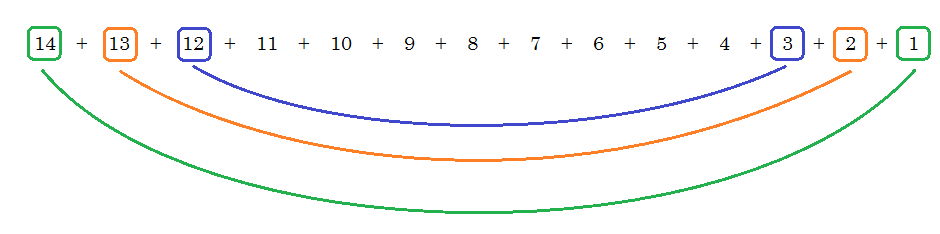
You can see, by paring the two extreme numbers will always give sum of 15. Now, you can quickly think that there are even numbers, so the number of pairs would be half the number of integers. As there are total 14 integers, so number of pairs would be 7. In short, you need to multiply 15 with 7, as there are 7 pairs having sum of 15 each. So total sum would be 15 multiplied by 7. In case, when the number of integers odd, eliminate the middle integer temporarily and make pairs for remaining even integers, whose pares is always half. After you find some, by multiply number of pairs with the sum in each pairs as we did in above, add the middle integer.
So, here as number of pairs are 7, and sum of each pairs is 15,
⇒ Total handshakes = 15 × 7 = 105 Answer
Method 2:
The second method is through use of average equation. But here’s again a short cut, and the easiest way. This is most recommended method. But this method will be discussed in ‘statistics’ lecture later on.
Now, let’s do next level concepts with advance and complex tricks.
Probability of dependent events:
When it is rain, there will be no class.
Here having class depends on not having rain, and vice versa. Remember that when the two events are dependents, they are mutually exclusive. When we draw this in sets or venn diagram, the two sets will never overlap, because they are mutually exclusive.
Suppose, the two events A and B are mutually exclusive of each other. And probability of happening event A is 0.40 and that of event B is 0.45. What is the probability of happening either event A or event B?
Solution:
Always remember, when the two events are mutually exclusive, then because of no overlapping region, the probability of either event A or even B to happen would be as follows:
Probability of either event A OR B will happen = P(A ∪ B)
Where ∪ is known as Union, which is basically means the sum (i.e + sign). Remember, when the two sets overlapped, then the overlapping region will be counted twice. Because A + B will be counted twice of its overlapping region. Those who still not understood, may ask me on WhatsApp.
Now, remember whether the two sets are mutually exclusive or not, i.e overlap or don’t overlap at all,
P(A ∪ B) = P(A) + P(B) – P(A ∩ B)
As I said it’s same as we’ve discussed in venn diagram. i.e Circle A + Circle B – Both (because both comes twice).
If the two sets don’t overlap, A ∩ B = 0
So in mutually exclusive events,
P(A ∪ B) = P(A) + P(B) (As A ∩ B = 0 in this case)
NOTE: Probability of either event A or event B is the thing that we have discussed in Venn diagram lecture before. The region is the one that cover only A + only B + both region. Such that the both region will not count as twice.
Probability of independent events
If it is rain, we will go for picnic or also we may not go.
Here going picnic not depends on having rain. Remember that when the two events are independents, they are not mutually exclusive. When we draw this in sets or Venn diagram, the two sets will overlap, because they are not mutually exclusive. So you must be clear that when the two sets are independent, they will not overlap, and hence they are not mutually exclusive. And if two sets are dependent, they are overlapping and hence they are mutually exclusive. In question, you might be told that the two sets are dependent or independent. From that information you must know what does it mean.
Let’s move on to other scenario
Alright, let me ask you, a silly question.
If a dice is thrown five times, what is the probability of having the sum an even integer?
Try yourself first. 🙂
If you tried, then its fine. As majority of you got right, because the question was very simple but confusing a bit. The answer is simply 0.5. As there is 50% chance of having even and 50% chance of having the sum an odd number.
It was fine, but let’s make move on to harder way.
If a dice is thrown seven times, what is the probability of having the sum multiple of 10?
solution:
It’s a somewhat higher difficulty level question now. You should attack such question by checking limit of the outcomes. The least sum and the maximum sum.
The least sum would be 7 when it will result 1 in all seven throws. And the maximum sum will be 42 when it will result 6 in all seven throws.
So automatically the required number of ways = 4 (10, 20, 30 and 40 possible within the limit of outcome)
And, total outcomes = 42 (As 6 × 7 = 42)
Those who didn’t understood may ask me on WhatsApp that how we found total outcomes as 42.
So probability of having sum multiple of 10 = 4⁄42 = 2⁄21 Answer.
Let’s move on.
If a group of six students has to sit such that three girls always sit at front and three boys always sit at behind girls. How many ways these six people can sit?
In such type of questions, you can see some class of people are fixed to a place, while other class fixed to other place. But there are different possible arrangements within same class. So we’ll find number of ways within the same class of both who can sit in different number of ways. After that, we’ll see whether it’s case of AND or OR. And we’ll finally multiply or add accordingly.
Number of ways three girls can be arranged in three seats at front = 3! = 6 (It’s basically 3P3)
Similarly, Number of ways three boys can be arranged in three seats at behind = 3! = 6
Note that we have to find arrangement of 3 girls AND 3 boys i.e 6 people, rather than 3 girls OR three boys i.e 3 people.
So we’ll multiply arrangement of girls (i.e 6) with arrangement of boys (i.e 6).
⇒ Number of ways 6 people can be arranged = 6 × 6 = 36 Answer.
At this stage, let’s do very hard level question scenarios in probability question.
There are three blue marbles, three red marbles, and three yellow marbles in a bowl. What is the probability of selecting exactly one marble of each color from the bowl after three successive marbles are withdrawn from the bowl?
First try yourself, then you may check whether you done it well.
solution:
Now, as your level of understanding is now become very fast and good, so let’s solve it by skipping some steps. If anybody don’t understand at any point, you he/she may ask me on whatsapp.
Suppose first marble was blue, second red and third yellow:
Probability of selecting the marbles in our pre-supposed pattern = 3⁄9 × 3⁄8 × 3⁄7
Probability of selecting the marbles in our pre-supposed pattern = 1⁄3 × 3⁄8 × 3⁄7
Probability of selecting the marbles in our pre-supposed pattern = 1⁄8 × 3⁄7
⇒ Probability of selecting the marbles in our pre-supposed pattern = 3⁄56
Many people perhaps though this is the answer, unfortunately it’s not 🙂
There are 3! ways that the three different colored marbles will be selected on three selection. In other words, it may be possible blue is selected in first selection, or red, or yellow. So three ways in first selection. Now, after first selection is made, then other two colors remain to select. So to select that two colored marbles has two ways and finally for last marble left, only one way to select. As we need to select three marbles, so it’s case of Marble 1 AND marble 2 AND marble 3. So we’ll multiply and the result is 3! That is the point we already discussed earlier. There are two ways to get number of orders or arrangements where order mater. First by using permutation equation, and second by using this method as discussed above.
So there are 3! which is equals to 6 ways to select three different colored marble. Therefore, we need to multiply this by 3⁄56,
⇒ Probability of selecting exactly one marble of each color = 3⁄56 × 6 = 9⁄28 Answer.
Let’s move on to one of the most tricky GMAT question.
If a bowl contains numbered tiles labeled with integers from 1 – 100, inclusive, what is the probability of selecting a tile with a three on it?
First try by your own then consult below:
solution:
First, let me tell you what mistake was committed by majority of you.
First of all, integers in the series of 3, 13, 23, ……93 are total 10. Each integer has one 3, EXCEPT 33, which was point of trick. so in this series you have total eleven 3s. Alright it’s fine. Next,
Secondly, integers in the series of 30, 31, 32, …. 39 are total 10. But we already have counted an integer 33 in previous series. So here are remaining 9 other integers having 3’s. Here each integer has one three, EXCEPT 33 again. But you have already taken 33 into your counting in previous series. So all in all in this series there are total nine 3s.
So 11 + 9 = twenty 3’s
But unfortunately its wrong. You just loose little focus while understanding the question in real sense. You need to understand that we need to answer number of integers that has 3’s rather than number of 3’s in integers from 1 to 100 inclusive. So you’ll conclude integer 33 is only one that has 3’s. that was the main tricky point.
So bottom-line is that there are total 19 integers (i.e 10 integers from former series and 9 from later series).
Now,
Probability of selecting a tile having a 3 digit = 19⁄100 Answer.
I hope this concept has now much clear to each of you. So let’s discuss a final hard level scenario.
Diana is going on a school trip along with her two brothers, Bruce and Clerk. The students are to be randomly assigned into 3 groups, with each group leaving at a different time. What is the probability that Diana leaves at the same time as AT LEAST one of her brothers?
solution:
In these type of questions, we need to see how many ways her brothers can be assigned in three groups such that both brothers may also assigned to a group. After that we’ll able to see the probability of Diana be assigned in same as AT LEAST one of her brothers. Remember the word AT LEAST has its own significance.
Brothers can be assigned in mainly two options: assigned both in same group and assigned both in different group.
Let’s take first option, and see how many ways Diana can be assigned to the groups.

You may draw the thing like above figure. So when the two brothers assigned together, Diana will able to assign in 3 ways. One of the way is drawn above, and next two tick marks in place of the cross marks will be the other two ways.
Now, let’s take second option when both brothers assigned to different groups. And see how many ways Diana can be assigned to the groups.

There are six ways that the two different tick marks can be placed in three groups. One of the way is drawn above. How do we know that there are six ways is by using the equation of permutation, where we have three places and two people to place. Now let me ask: are there six ways the two brothers can be placed at three places when assigning different positions?
The answer is no! As the two brothers are different, that’s why I’ve used each tick mark with different name i.e b and c. For instance, in above diagram, if b and c are interchanged with each other, it will result another way how both brothers may be placed.
Now as there are 6 ways to arrange two brothers in different groups, and each way includes two tick marks (i.e two possible places of Diana with brother), so There are 6 × 2 = 12 ways that Diana can be placed with her brothers while each brother are assigned to different groups.
Now, Diana can be assigned to groups in = 3 + 12 = 15 ways. So the required outcome is 15.
Let’s find the total outcomes.
Total outcome = required outcome + non-required outcome = 15 + non-required outcome.
And
Non-required outcome includes number of ways in which Diana should not assign in same group as each of the two brothers. Again let’s see from the two options given in the two diagrams above.
In first option,
Diana can be assigned to 2 × 3 = 6 ways (As each way has 2 places and there are 3 ways of arrangements).
In second option where two brothers not assigned to same group,
As each way has 1 place, but brothers if interchanged make two ways for each place, and there are 3 ways of arrangements
Diana can be assigned to 1 × 2 × 3 = 6 ways
So, non-required outcomes = 6 + 6 = 12 ways
⇒ Total outcomes = 15 + 12 = 27
Therefore,
Number of ways Diana can be assigned to groups with AT LEAST one of her brothers = 15⁄27 = 5⁄9 Answer.
The last one was the hardest level question scenario in probability.