
Word Problems
Probability & Combinatrics
This is one of the most important and perhaps, for most students, the hardest topic of quantitative section. Let’s learn this with different scenarios and in as much depth as it comes in such exams. Let’s start!
Probability:
Probability is something about chance of happening an event or not happening the event. It’s answer always lies between 0 and 1 inclusive. In other words, probability of any event cannot be greater than 1, and neither it can less than 0.
Remember that:
Probability = Required Outcomes⁄Total outcomes
Suppose, If a coin is tossed, what is the probability of getting a Head?
As there are total two outcomes i.e Head and Tail.
And required out come is one i.e Head. So,
Probability of getting a Head in one toss = 1⁄2
⇒ = 0.5
If we want it to be expressed in percent, then simply multiply this by 100 as follows:
Probability of getting a Head in one toss = 1⁄2 × 100 = 50%
So there is a 50% chance that the outcome would be Head if a single coin is tossed.
Now, suppose two coins are tossed, what is the probability of getting at least one Head?
Remember the words like ‘at least‘ are very important. For instance, in order to pass an exam, a university require you to secure at least 50% marks. That means minimum 50% is required, while if you attempt for the exam after very good preparation and get 92% marks, again you will be (even more acceptability with scholarship) considered as pass. So at least 1 Head means 1 Head or 2 Heads in two coins toss. Also remember that two coins toss and one coin toss twice would give same results in terms of probability of any required outcome.
So here,
Probability of getting at least one Head = Probability of getting one Head or Probability of getting two Heads
Remember that in probabilities and overlapping sets (Venn Diagrams), word ‘or’ is transformed to ‘+’ while the word ‘and’ is transformed to ‘ב
So
Probability of getting at least one Head = Probability of getting one Head + Probability of getting two Heads
⇒ = 2⁄4 + 1⁄4 (As there are total four outcomes: HH, HT, TH and TT)
⇒ = 3⁄4 = 0.75
Let’s move on
If a coin is tossed 7 times, what is the probability of getting at least 4 heads? ———————– (equation 1)
In order to answer this in short way, you need to understand little about Combinatrics and then arrangement of characters of a word. And remember that the answer of Combinatrics may be greater than 1 but never less than 0.
And also remember the relationship between probability and combinatrics is that, numerator and denominator of probability equation (which have been mentioned before) combinatrics is used(i.e number of ways or outcomes); Number of ways or outcomes is basically result of combinatrics. In short Combinatrics is about number of ways or outcomes: Required ways and Total ways.
Combinatrics:
It has two topics: 1. Permutation and 2. Combination
Many students usually confuse these two terms, and many times asked me when to use permutation and when combination as no information is given whether it’s permutation question or a combination question. Only the words like ‘how many ways’ is mentioned which doesn’t tell whether it’s permutation or combination. Let’s learn how to check this.
Let’s suppose three people, A, B and C have to be sit in three different chairs. How many ways these three people would sit in those chairs?
First tell me these three people would arranged in how many way diagrammatically? For answer, see bellow:
A B C
A C B
B A C
B C A
C A B
C B A
That’s it. There are six ways you see. It was quite easy as number of people or number of chairs are very few. But what if we were asked arrangement of 5 or more people to be arranged. There are 120 ways. How I find in few seconds? It’s simple. First let’s solve for three people A, B and C. The answer would be as follows:
There are three places/chairs as follows:

Now, in first chair, how many ways a person can be placed? Well A may sit here, B may also sit and C also may sit. So there are 3 ways to fill first place, so:
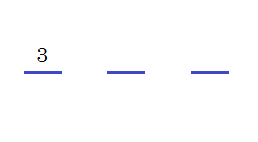
Now one person from the three has sit in first place. After this, in second place how many ways to sit a person. Obviously two people are remaining so there are two ways. Hence,
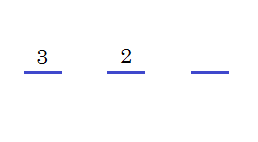
Now, last person is remaining and last place, so there’s only one way to place him at that place. Finally, we have number of ways of placing the three persons in three chairs as follows:
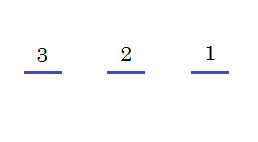
Now, multiply these, you’ll get the required number of ways in which three people may placed in three different chairs as follows:
Number of ways = 3 × 2 × 1 = 6
Similarly, you may find number of ways 5 people can be placed in 5 different chairs as 5 × 4 × 3 × 2 × 1 = 120 ways.
Remember that 3 × 2 × 1 is termed as 3! and spoken as ‘three factorial’ in quantitative section. Similarly, 5 × 4 × 3 × 2 × 1 is written as 5! and spoken as ‘five factorial’. So in general, n × (n – 1) × (n – 2) …….. 3 × 2 × 1 = n! (and said as n factorial), where n is a positive integer.
Also it’s very important to remember that 0! = 1 and also 1! = 1
Because 0! means in how many ways nothing can be arranged? The answer is 1 way and that is 0. Here answer is how many ways not how much. So number of ways is 1, but how much is 0. So don’t confuse this. Just remember 0! = 1
Similarly, 1! means in how many ways 1 person can be arranged? the answer is again 1 way that is 1.
The above thing that we learned is permutation.
Now let’s learn difference between permutation and combination.
Permutation:
Remember that when order maters then it’s permutation. For instance, in above example of three persons A, B and C
(A B C) and (B A C) are different ways, so here order mater (i.e order of placing persons mater). So it’s permutation.
There are two ways to solve permutation. One that we have learned before but will learn again with some different scenario. And first Method is recommended:
Method 1
Suppose 5 persons have to sit in 3 different chairs, how may ways those 5 persons may sit?
Simple,
As there are three places and in first place 5 ways people can sit. Then 4 ways for next place to sit. And finally 3 remaining people would sit in 3 ways for in chair. In short:
5 × 4 × 3 = 60 Answer.
Method 2:
Use the following equation for permutation:
nPr = n!⁄(n – r)!
Where n and r are number of people and chairs. Remember here that which ever is greater from people or chairs would be n, and which ever is less would be r. If both are equal, you may say anyone of two as n or anyone as r in that case.
So here, we’ll have:
5P3 = 5!⁄(5 – 3)!
After solving this, you’ll get same asnwer as in Method 1 = 60
Combination:
Where order doesn’t mater is combination. For instance,
From the class of 10 students, in how many ways 3 students would be selected as teaching assistant?
Here you see that the position or place is only one i.e teaching assistant, while persons are three. So here if A comes first or come second in that selection, doesn’t mater to A. He is happy for being selected. That’s it.
Here equation is used as follows:
nCr = n!⁄r!(n – r)!
So
10C3 = 10!⁄3!(10 – 3)!
Most important:
Always use following way to solve this in quick steps:
10C3 = 10!⁄3!(10 – 3)!
⇒ = 10!⁄3! 7!
⇒ = 10 × 9 × 8 × 7!⁄3! 7!
⇒ = 10 × 9 × 8⁄3 × 2
⇒ = 10 × 3 × 4 = 120
Arrangement of characters:
At this stage, you are ready to learn how may ways the characters of the word ‘MISSION’ can be arranged to make different words?
Solution:
Just use this unique way:
In such scenario, number of ways = (number of total characters)!⁄(number of times a character repeats)!
And if two or more character repeats, then write in denominator. For instance in MISSION, I repeats twice as well as S repeats twice. So we’ll write 2! and another 2! in denominator as follows:
Number of character arrangements = 7!⁄(2! 2!)
Solve it, then you’ll get,
Number of character arrangements = 1260
Now, let’s move on to question in equation 1 again and solve it.
If a coin is tossed 7 times, what is the probability of getting at least 4 heads?
At least 4 Heads = 4 Heads or 5 Heads or 6 Heads or 7 Heads.
Now, in case of 4 Heads, there must be 3 tails. And we can arrange it’s characters by 7!/(4! 3!), because H(i.e Head) repeats 4 times and T(i.e Tails) repeats 3 times. And similarly you may find number of ways for 5 Heads and 2 Tails may arranged, 6 Heads and 1 tail and finally 7 Heads may arranged.
So we’ll get finally,
Number of ways of getting at least 4 Heads (i.e Required outcome) = 35 + 21 + 7 + 1
Number of ways of getting at least 4 Heads (i.e Required outcome) = 64 = 26
Now Total outcome is always (remember in case of coin having two outcomes) = 2n
where n is number of times a coin is tossed or number of coins toss
So, Total outcomes = 27
So Probability of getting at least 4 Heads = 26⁄27
Probability of getting at least 4 Heads = 1⁄2 Answer.
With replacement vs without replacement:
Suppose, a card is selected at random from 52 cards with replacement. Then another card is selected from the cards. What is the probability o getting two Kings?
As we know there are total 4 kings. Now probability of having a King in first selection is 4⁄52 = 1⁄13
Now, as it’s said with replacement. So it means we must put the first selected card (Let’s it’s King), back to total cards. And then select the second card from the same total number of cards (i.e 52). So probability of having another King would be same i.e 1⁄13.
Hence probability of having both Kings = 1⁄13 × 1⁄13 = 1⁄169
Now, if question ask a card is selected at random from 52 cards without replacement (or this word ‘without replacement’ not mentioned in question) then you need to do the following thing:
Probability of getting first King is same as in previous because we have 52 cards and 4 are Kings. And that is 1⁄13
Now probability of getting second card to be King = 4⁄51
As the first card selected didn’t put back into the total available cards. So in second selection, total number of cards would become 51.
So finally we’ll have different answer here.
Now, let’s discuss frequently used scenario in GRE exam. Remember that in GRE exam, probability questions are little easy as compared to these questions in GMAT exam.
Friha placed 3 white balls, 5 green balls and 7 yellow balls in her playing box. If she put three balls at random from her box, what is the probability that all of the balls she selected are white balls?
solution:
First, use commonsense and thing whether it’s a case of with replacement or without replacement? It’s clearly without replacement. Because she picked the three ball altogether, which is same as picking first ball, and then second without placing back the first one. And similarly picking third ball without placing back first and second balls.
So,
Probability of having fist ball white = 3⁄15 = 1⁄5
Now, first ball is picked. We are going to pick first ball AND second ball AND then their ball. So we’ll find the probability of having second ball also as white and third ball also as white. Finally we’ll multiply all three probabilities because AND is converted to multiplication sign.
Probability of having second ball also white = 2⁄14 = 1⁄7 (As 2 white balls left, and total 14 left)
Similarly,
Probability of having third ball also white = 1⁄13 (As 1 white balls left, and total 13 left)
So,
Probability of having all three white balls = 1⁄5 × 1⁄7 × 1⁄13
Probability of having all three white balls = 1⁄455 Answer.
Now, let’s do the other way around.
In above question scenario, what is the probability that Friha will pick none of the ball as white?
solution:
Now,
Probability of first ball that should not be white = 12⁄15 = 4⁄5
As it was without replacement, so
Probability of second ball that should not be white = 11⁄14
Similarly,
Probability of third ball that should not be white = 10⁄13
By multiplying all these to get probability of all three balls selected as non-white, we’ll get
Probability of picking none of the three balls as white = 4⁄5 × 11⁄14 × 10⁄13
Probability of picking none of the three balls as white = 2 × 11⁄7 × 2⁄13
Probability of picking none of the three balls as white = 44⁄91 Answer.
Important concept:
If in the question it were ask about probability of selecting at least one white ball, you need to just subtract probability of none of the white balls from total probability (i.e 1). As 1 is the probability of selecting any ball from given ball. In other words, total probability is 1, which is probability of selecting any ball from total number of balls. For instance if a coin is tossed, probability of having head is 0.5, and probability of tail is also 0.5. And the sum of all probabilities (i.e probability of head + probability of tail) is 1.
So if we subtract probability of none of the balls from 1 (i.e total probability), we’ll get chance of having at least one white ball. As OR is converted to + sign, so probability of at least one white ball = probability of exactly one white ball OR probability of exactly two white balls OR probability of all three white balls = = probability of one white ball + probability of two white balls + probability of all three white balls.
So probability of having at least one white ball = 1 – 44⁄91 = 47⁄91 Answer.
In previous question scenario, what is the probability that Friha will pick exactly one white ball?
solution:
Suppose, she pick first ball as white and remaining two as not white.
⇒ Probability of selecting first white ball = 3⁄15 = 1⁄5
AND
Probability of selecting second ball as non-white = 12⁄14 = 6⁄7
AND 6/35
Probability of selecting second ball as non-white = 11⁄13
So probability of selecting first white and remaining non-white = 1⁄5 × 6⁄7 × 11⁄13
So probability of selecting first white and remaining non-white = 66⁄455
Now, It is possible that white ball will be picked up in first selection OR picked up in second selection OR picked up in third selection. And if you do same calculation for picking up white ball in second selection, whilte having non-white ball in first and third selection you’ll get same result. i.e 66⁄455, and similar result in case of white ball picked up in third selection.
So as it’s case of OR that will convert to + sign, so
Probability of having exactly one white ball in three picks = (66⁄455) × 3
⇒ Probability of having exactly one white ball in three picks = 198⁄455 Answer.
In previous question scenario, what is the probability that Friha will pick exactly two white balls?
solution:
This is somewhat harder and most important type of scenario that may be come in GMAT as well. But as you’ve learned previous concepts and improving your level of understanding probability concepts, it’s no more hard 🙂
We’ll do same as in last scenario question. First we’ll suppose in first and second pick, she got white ball, and in third pick she didn’t got white one. After getting probability of this, we’ll multiply with number of ways in which she can pick two white balls in three picks. This is not different from what we did in last scenario, where number of ways of having one white in three picks was 3. Because one white may come in first pick, or in second pick or in third pick. So we have added the same result three times, or in short multiplied the result with 3, which is number of ways of having one white in three picks. Same thing we’ll do here.
Probability of having first two white and third not white = 3⁄15 × 2⁄14 × 12⁄13
Probability of having first two white and third not white = 1⁄5 × 1⁄7 × 12⁄13
Probability of having first two white and third not white = 12⁄455 —————————– (eq. 2)
Now, we need to find how many ways she can pick two white from three picks. First ask yourself, whether order matter? The answer is yes, so we’ll use permutation. Also if order mater, as in case of arranging characters of a word.
Total Characters or picks = 3 (As two white and 1 other colored)
White repeats = 2 times
⇒ = 3!⁄2)! = 3
So,
Number of ways she can pick two white from three pics = 3
⇒ Probability of having exactly two white balls = 12⁄455 × 3 = 36⁄455 Answer.