
Word Problems
(Work-Rate)
As we read before in ‘GAT Quantitative Part-1’, the relationship between Distance, Speed & Time. Distance is like Work done (that how much distance covered means how much work done). Speed is like Rate (that how much miles in a hour the work takes to be done). So, in other words we can write the same formula for the relationship between Work, Rate and Time.
Work = Rate × Time ———————— (eq. 1)
Now, let’s discuss different scenarios of work-rate problems.
1) When change in same variable happen:
For instance,
If 10 workers can paint 40 chairs in 5 hours, then how many people can paint these 40 chairs in 2 hours?
Solution:
Always take variables in such form that place together the variables that are fluctuating, while placing constant variable separate as bellow
People Time Work
10 5 40 (With old conditions)
(x) 2 40 (With new conditions)
Now, you see that work doesn’t changes, so we can ignore this variable while answering question.
Also there’s same work required to be done within relatively less time duration of 2 hours compared to 5 hours with old condition. Common sense suggest people requirement must be more than 10. Now, you see there is inverse relationship between people and time, so in case of inverse relationship, always use this way to make equation.
In case of feeling inverse relationship between variables (i.e people & Time):
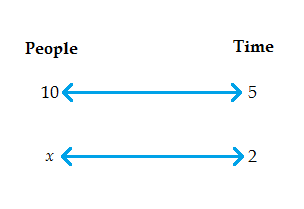
⇒ 10 × 5 = x × 2
⇒ x = 25
Many students try to use unity method here, i.e. first find people requirement in one our (i.e rate) and then multiply with 2 on both sides to get required number of people doing job for 2 hours. This would give wrong answer. Please avoid unity method as much as you can in work-rate problems, because unity method only works where there’s a direct relationship between variables. Direct relationship means when one variable increase, the other also increase and vice versa. Here’s the relationship between people and hours is inverse( i.e, with decrease number of hours requirement, people requirement increase), unity method would give wrong answer.
Similarly, in case of three or more variables, we always do same thing, but additionally, take care of the two things while dealing with three or more variables: 1) Always write that variable at middle whose value needs to be find with new condition (We’ll take it’s example bellow). 2) Always find relationship whether direct or indirect while taking two adjustment variables together and ignoring third variable (we’ll take it’s example bellow as well).
Now, let’s take application of the above two points by example for further understanding with practice.
For instance, if 10 people require 5 hours to paint 40 chairs, then 50 people require how many hours to pain 100 chairs?
Solution:
First of all, write down variables in a raw and their values with both old condition and new condition as follows:
People Time Work
10 5 40 (With old conditions)
50 (x) 100 (With new conditions)
Now, let’s consider first two variables (people & time) and find it’s relationship (whether direct or indirect) as follows:
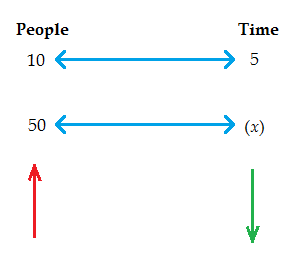
Now, you see that number of people are increased, so the time requirement must be decrease. Remember that although work is also increase, but as what I said just ignore the third variable while finding relationship between the two variables.
Now, find relationship between other two variables (Time & Work) and ignore first variable (People) as fellows:
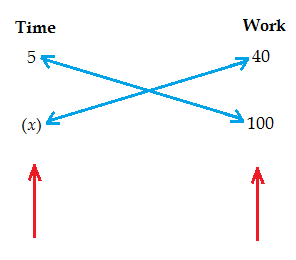
You see that, as the work load increase, so the time required to do that work also would be increase. This is direct relationship; and in direct relationship, always remember to have cross multiply as above figure.
Remember, as you see, while taking first to variables (People & Time), Time was decreased, but while taking other two variables (Time & work), Time increased. So never confuse at this point, just forget relationship of first two variables while finding relationship between other two variables.
At this stage, just merge the two relationships as follows:
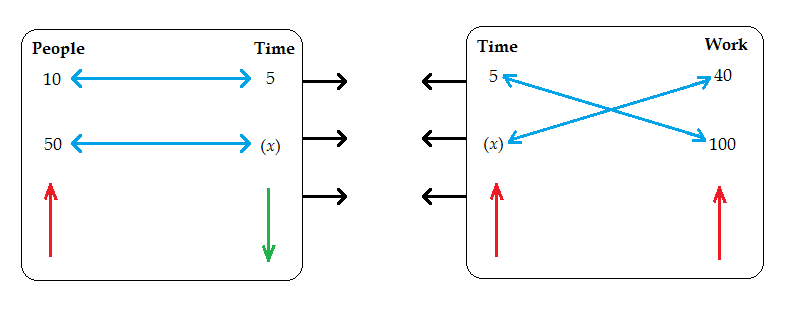
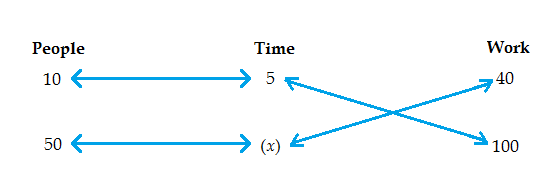
Now multiply values with right directed blue arrows at one side of equation, and values left directed blue arrows at other side as fellows:
⇒ 10 × 5 × 100 = 50 × x × 40
⇒ 5 = 2x
⇒ x = 2.5 hrs Answer
2) When working together or separately happen:
In this scenario, you just need to remember (eq. 1) mentioned at start of this topic; you can see at start of this page.
For instance,
Working alone a father can paint his home in 8 days, while his son can do the same job alone in 6 days. How many days would it take for both of them if they start paint together that home simultaneously?
Solution:
Well always start to find the individual rates of both persons. i.e
Rate of father:
As we know: Work = Rate × Time
⇒ Rate = Work⁄Time
⇒ Father’s Rate = 1⁄8 (As work is to paint full house not half or part of it, so work is 1.)
Remember in these cases, just take work as 1, for instance to fill water tank or to do certain job etc is 1 work.
Similarly, Son’s rate = 1⁄6
Now, when both father and the son work simultaneously, their individual rate would add up as bellow:
Combined rate = {1⁄8 + 1⁄6}
⇒ = (3 + 4)⁄24 = 7⁄24
As we know that, Work = Rate × Time
By putting values,
⇒ 1 = 7⁄24 × Time
⇒ Time = 24⁄7 days Answer
Let’s move on to some harder difficulty level questions,
In a water tank, pipe A alone can fill the tank in 6 hours while. Pipe B alone can do the same job in 3 hours, while pipe C alone can do so in 2 hours being powerful than others. If Pipe A start filling the tank for an hour. After an hour pipe B also started filling the tank and both together do the job for an hour. After that, pipe C joined and then together all three pipes filled the tank. What part of the whole job was done by pipe B?
Solution:
As I mentioned early, in working together scenario, that always find individual rates first then do next steps. So let’s find rates of the three pipes.
Rate of Pipe A = 1⁄6 (As Rate = Work⁄Time & work is 1)
Rate of Pipe B = 1⁄3
Rate of Pipe C = 1⁄2
Now, PA (i.e pipe A) did job for an hour alone, so this pipe did 1⁄6 of total work, as rate gives the work per time i.e hourly work, daily work or work per minute, depends on time unit; here time unit is hour so we’ll say pipe A can do 1⁄6 of work in an hour which is the rate of PA.
After an hour, 1⁄6 of the total work (which is 1) is done, so remaining work(1 – 1⁄6 =) 5⁄6 is to be done next.
Now, after PA done work for an hour PB joined PA and both worked for an hour together.
As we always need to find rates first, in individual case, we’ll find individual rates; but in combined work case, we’ll always find combined rate.
⇒ Combined rate of PA and PB = 1⁄6 + 1⁄3 = (2 + 1)⁄6 = 3⁄6 = 1⁄2
So both PA and PB together done 1⁄2 of the work in an hour, i.e
(Combined Rate of PA and PB) × Time = Work
⇒ 1⁄2 × 1 = Work
⇒ Work done by PA and PB together for an hour = 1⁄2
Now, after an hour when both PA and PB worked, the remaining work (5⁄6 – 1⁄2 = (5 – 3⁄6 =) 1⁄3 is to be done next.
Now, PC joined the two pipes and together all three of the pipes finished the remaining work (1⁄3). So combined rate of all three pipes = 1⁄6 + 1⁄3 + 1⁄2 = (3 + 2 + 1)⁄6 = 1
Now, according to the given condition, as we know
(Combined Rate of PA, PB and PC) × Time = Work
⇒ 1 × Time = 1⁄3
⇒ Time = 1⁄3
This is the time taken only when all the three pipes worked together after 1⁄3 of the work was remaining.
Now, let’s find out the part of work done by PB which is the required question.
In first hour when PA worked alone, PB didn’t work. In second hour, when PB joined PA and both worked together for an hour, PB worked for:
Rate of PB × (Time taken when only PA and PB worked together) = Work
⇒ (1⁄3) × 1 = Work
⇒ Work = 1⁄3 —————————– (eq. 2)
Now,
After two hours, when PC joined both PA and PB, and all three pipes worked together to finish remaining 1⁄3 of the task in 1⁄3 hour, PB worked for:
Rate of PB × (Time taken when all three pipes worked together) = Work
⇒ (1⁄3) × (1⁄3) = Work
⇒ Work = 1⁄9 —————————– (eq. 3)
By adding (eq. 2) and (eq. 3), we’ll get the total work done by PB as follows:
1⁄3 + 1⁄9 = (3 + 1)⁄9 = 4⁄9
Now, we need to find fraction of work done by PB. As the word ‘fraction of’ is proceeded by the ‘work’ which is 1, so we’ll take it as reference and write in denominator; In numerator, we’ll write total contribution of PB to fill the water tank as follows:
Fraction of Work done by PB = (4⁄9)⁄1
⇒ = 4⁄9 Answer
Let’s learn another scenario that is most frequently tested in GRE exam.
Working together with his son, a man can paint a home in 15 days. While working alone the man will take 20 days to paint the home. How many days will it take the son to paint the same home working alone?
There was no answer choices with this question. In GRE you’ll see some question with no answer choices. And you have to enter the value of answer in a rectangular shaped area that would be given below the question.
Solution:
Here method would be the same, as discussed above in working together scenario. As you know the steps at this stage, just skip few steps like I’m doing below, because now you should start do things fast.
{(1⁄20) + (1⁄A)} × 15 = 1
Those who didn’t understood what’s going on, 1⁄20 is the rate of the man and 1⁄A is rate of his son that we supposed the son will require A days working alone. 15 is time required by both working together. While 1 is (as I said) almost always work.
By solving the above we’ll get
⇒ {(A + 20)⁄20A} = 1⁄14
⇒ (A + 20) = 20A × (1⁄15)
⇒ A = (4A⁄3) – 20
⇒ A = {(4A – 60)⁄3}
⇒ 3A = 4A – 60
⇒ A = 60 days Answer