
Critical Reasoning (Assumptions)
What is assumption?
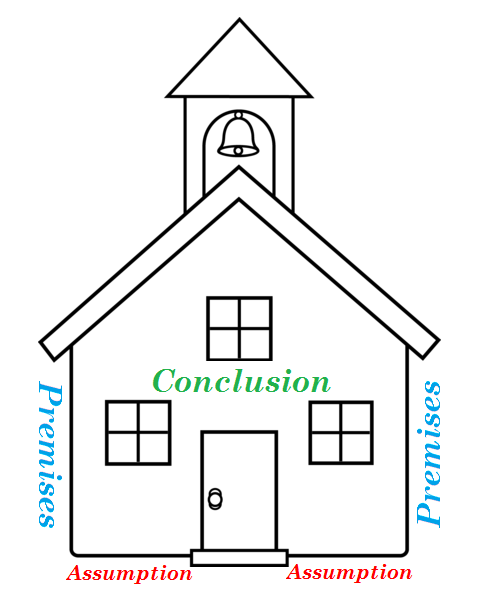
Firstly, perhaps you have already studied little bit about assumptions in FREE Basic Verbal concept-01, before starting exam preparation here. An assumption is a hypothesis or an opinion that the author of the argument believe while stating an argument. But he never state the assumption in his argument, rather the assumption is implied. Remember that assumption is the base on which the whole argument stands. The figure below will help you to understand the role of an assumption in an argument:
Why is it important?
Have you noticed the figure above that assumption is the basis on which the whole argument depends? If assumption is logical and strong, the whole argument will become sound and convincing. Otherwise, the argument might collapse; i.e it might be called into question by anybody. So why is it important is because assumption is the most critical part of an argument, that is never stated but hidden underground. There are basically two roles of assumptions:
1. Fill the logical Gap between premises and conclusion.
2. Validate and make the conclusion MUST be true.
Thus, in order for the conclusion to be true, the statement that must be true is assumption. In other words, validity of conclusion of an argument depends on its assumption.
What skill is tested about assumption?
As I mentioned before that assumption is never stated in a argument, rather it is implied; so this skill of accurately extracting that hidden assumption of the author is tested in a exam. For instance, Sports analyst said:
“All those basketball players who are tall can easily become champion. Therefore, it is their height which enables them to become champion”
Which of the following is an assumption of the sports analyst argument above? (Indicate all that apply)
I. Taller basketball players do not possess other skills to become champion.
II. All champions of basketball are tall players.
III. Taller basketball players do not have more accuracy than others to through the ball to target goal, at some distance .
Solution:
Firstly, it is highly recommended to read the question statement first, before reading the argument. Also after reading the question stem and then the argument, make your own guess for the answer in your own words and before looking toward answer choices. It is very important and helps you in different types of critical reasoning or logical reasoning questions, that we will discuss in verbal section of this preparation later-on.
Also, it is important to know that there may be many assumptions that can be drawn from a given argument. Yet, you are advised to do self-analysis and draw only one whatever comes in your mind at that time. Even if that assumption do not exist in answer choices, your self-analysis will help you to know the logical gap between premises and conclusion. While focusing on the conclusion of the argument and having an objective to make this conclusion valid, think about a statement that must be true in order for the conclusion to become valid. In most of the arguments, the author will discuss one thing in premise/premises, but will draw a different thing from that. So your mission is to connect the two different things, i.e. how first thing ( stated in premise) will lead to the second thing (stated in conclusion).
Self-analysis:
After thinking critically, you will imply that if tall players can easily become champion, then there must be no other special attribute that taller players possess other than their height to easily become champion. From this assumption, together with the premises, conclusion of the argument MUST be true.
Let’s see answer choices one-by-one and pass by negation test:
Choice I: This statement is similar to what we supposed. But let’s pass it through negation test:
In negation test, we will either write word ‘not’ or eliminate this word if it already exists.
“Taller basketball players do not possess other skills to become champion.”
This clearly makes the conclusion no more valid, i.e it breaks the conclusion. So this choice is an assumption of the argument, because the negation of this statement has broken down the conclusion of the argument.
Choice II: First of all this choice is out of scope, as the assumption should not be about people who are already champions, rather its about people who can become champion. Also this statement is not a MUST be true statement. Few champions might not be tall. Furthermore, negation test do not break the conclusion. i.e Not all champions of basketball players are tall. So this choice is not an assumption.
Choice III: This statement gives the similar statement that we have supposed; It is also clearly the assumption of the argument. Furthermore, negation test confirms that this statement will break the conclusion of the argument if negated.
Similarly,
Let’s say, a sports analyst said:
“Mr A is tall and he has applied to basketball team. Therefore, he will be selected in the team.”
Which of the following is an assumption of the sports analyst argument above? (Indicate all that apply)
I. Only tall applicants are selected in basketball team
II. All basketball team members are tall persons
III. Any applicant who is tall will be selected in basketball team
IV. Any person who is not tall, but has applied to basketball team, will not be selected in basketball team.
V. Mr A was not injured or unfit.
Solution:
In this lecture, you will learn importance of tinny words in an argument. Also you will become precise and accurate while selecting a choice, that might seem false but actually true. Also you will easily eliminate the choices that seem to be true but actually false. Because when it comes to accuracy and precision, you will not ignore any small things.
The simple argument has following two parts:
Premises: Mr A is tall and he has applied to basketball team.
Conclusion: He WILL be selected in basketball team.
Remember that an assumption of an argument MUST be true, rather than COULD be true. So, before going to check answer choices, let’s think critically about this argument. You should develop a habit of argument self-analysis before going to answer choices. If you want to be expert in verbal, don’t rely solely on POE (i.e Process of elimination). First have a self-analysis of the argument by thinking critically, and think the answer in your own words. After that go to the answer choices to do three things: 1) compare with your answer, 2) POE and 3) In case you stuck in 2 answer choices, apply negation test to get confirmation.
This will ensure you that you will always select correct answer choice, on which you will be more confident on that selection. So let’s have a self-analysis of this argument.
Self-analysis:
Your self analysis will result to the similar statement to believe as an assumption as stated below:
All tall persons, who have applied WILL be selected in basketball team.
Now, from this statement, together with the premises: “Mr A is tall and he has applied to basketball team”, we can surely conclude that ‘Mr A WILL be selected in basketball team’
It doesn’t matter whether Mr A is injured, or unfit. He will be selected in basketball team if we believe this statement as the assumption of the argument. Even if somebody criticize that Mr A is unfit, yet the argument will hold true; as injury doesn’t matter for selection in the team, according to the argument. Injury might matter in playing a basketball game, but here the argument only has talked about selection in the team. So injury or unfitness issues can be overcome after selection.
So let’s consider each choices one by one, and compare with our version that we derived after self-assessment.
Choice I: Think critically by taking this statement together with the premises of the argument. And tell me whether the conclusion of the argument MUST be true, or COULD be true? Also compare it with our supposed version. No! This statement is different from what we have extracted. If a person is tall, and this gives surety of being selected does not mean that only tall person will be selected. For instance, in FREE beginners study plan, you’ve learned that: All mangoes are tasty, but it does not mean that only mangoes are the thing that are tasty in the world. There might be other things as well that are tasty. Similarly, if all tall persons are selected, does not mean that only tall persons are selected. This choice is incorrect. So be precise! 🙂
Choice II: This statement is not MUST be true, as there is difference between selecting tall persons and already having tall members. And if a person is tall, he WILL definitely be selected does not mean that if a person is not tall, he will not be selected and hence cannot be the member of the basketball team. As the possibility exists, so this choice is not MUST be true, and, therefore, is not an assumption of this argument.
Choice III: This statement is exactly the same as our version of assumption, so this is correct choice.
Choice IV: This choice can clearly be eliminated, as we have discussed in previous choices that if any person who is tall will be selected does not mean that any person who is not tall will not be selected. The possibility exists, so this choice is not MUST be true. Thus this is not an assumption of the sports analyst.
Choice V: Finally, we have already discussed that injury or unfitness in this argument is not a matter in discussion. Injury or unfitness might matter only in play, rather than in selection because it may be recovered. So this choice is irrelevant and out of scope, and hence this is not an assumption.
I hope things are getting clear and your understanding is getting more accurate. So let’s discuss another most important perspective of this question known as Cause & Effect scenario, that is mostly tested in exam.
Such types of arguments states two statements, in which one is the cause and the other is the effect. In such questions, an assumption might be of two types:
1. There cannot be the other cause or causes of that effect, i.e only the given cause is the cause of the effect.
2. Cause is not due to the the Effect, but Effect was resulted due to the Cause. i.e cause must be independent of effect, but effect depends on cause. You may also say it as Cause happen before effect, but not after. Also you may say that effect does not cause the cause.
For instance, in a simple argument it is mentioned:
Increase in river water consumption in houses has resulted the water level of the river dropped.
Here,
Cause: Increase in river water consumption in houses
Effect: Drop in river water level
Assumption 1: The drop in river water level was not due to the increase in water consumption in agriculture lands.
and,
Assumption 2: The increase in river water consumption in houses was not due to the drop in river water level.
Sometimes, an argument includes information about two different events that are started almost at the same time. this is known as correlation. Two events correlate when they started almost together. I said you to read the argument while thinking critically. Because in such arguments, the author believes two correlated events to be causal events, i.e one event must have caused the other. To understand this, let’s consider another simple argument below:
Last year, a certain virus become viral in city X. Also, large number of people have died last year, compared to previous year. Therefore, it must be the spread of that virus which resulted to such increment in deaths.
Let’s first imagine the logical structure of this argument in our mind.
Even 1: Last year, a certain virus became viral in city X
Event 2: Last year, a large number of people died compared to previous year.
Conclusion: Thus, Event 1 must have caused Event 2.
Here, you may weaken the argument easily because two correlating events doesn’t mean they must have causal relation. So in this argument the following assumption are made:
Assumption 1: Event 2 doesn’t cause Event 1 (i.e Effect doesn’t cause the cause.)
Assumption 2: Event 3 doesn’t cause Event 2 (i.e There was not other reason for the Effect to happen except the stated cause).
For general information, you may weaken this argument by attacking assumption. For instance,

The large number of people have died at first & second quarter of the last year, while the virus became viral on the second-
last quarter of last year.

This statement clearly weakens the argument, because it states that the Effect happened before the cause. Thus, the stated
cause cannot be the actual cause.
Cause & Effect arguments are of two types:
1. Inductive reasoning
2. Deductive reasoning
In inductive reasoning, the argument flows from specific case to draw a general conclusion. While in deductive reasoning, an argument flows from general statement to draw a specific conclusion.
In inductive reasoning, the cause & effect relationship is written in the conclusion. For instance,
Last night, when I slapped on the face of my child, he got angry. Therefore, slapping on the face on a child makes that child angry.
The argument proceeds from a specific case to draw a general conclusion. As it proceeds from specific to general, so this is an inductive reasoning.
Here you may notice that “slapping on the face on a child makes that child angry” is cause & effect relationship and it’s stated in conclusion. While the two events were stated as simply correlating events in the premise. So conclusion has causal relationship.
Cause: Slapping on the face
Effect: Makes child angry
In such type of Cause & Effect arguments (i.e inductive reasoning type of Cause & Effect argument), the assumption might be anyone of the following:
Assumption 1: Slapping on the child face happens before the child gets anger or Slapping on the child face does not happen after the child gets anger.
Assumption 2: The anger of a child do not cause a slap on this face. (i.e The anger of the child does not cause somebody to slap on his face.)
and
Assumption 3: Slapping on the child face is the only reason to make him angry. or No other things happen with the child to get angry while slapping.
Now, let’s study deductive reasoning scenario, where the Cause & Effect is stated in the premises, rather than conclusion:
Slapping on child face makes him angry. Therefore, if I slap on my child face, he will react.
Here assumption will be the following statement:
Assumption: When a child is angry, he reacts as well. OR anger leads to reaction
This assumption fills the logical gap between premise and conclusion, i.e premise has discussed about anger, while conclusion has discussed about reaction. So there must be a connection that links between these two. That connection is basically an assumption.
In pre-thinking, always think about this logical gap. In many arguments, the author discuss something on premise and discuss
a different thing on conclusion. So think about that gap in pre-thinking of an assumption question. The pre-thinking will
most of the time lead you to the exact assumption in the answer choice. It will save time and improve your confidence over the
selected choice.
Also it is very important to note that here the assumption cannot be like Effect did not cause the Cause. i.e
The anger of child did not cause a slap on his face.
It is not the assumption here anymore, because the premise includes information that is a fact, rather than an opinion. So debate is not about whether slapping cause the child angry or the anger of child cause slap on his face. Here debate is about the reaction of my child while making a slap on this face.
I’ve said you in beginners study plan that the most important point of an argument is its conclusion. It is the focus of the argument. So an assumption creates link between premises and conclusion, rather than to question premises.
On other hand, in inductive reasoning Causal arguments, where the Cause & Effect is stated in the conclusion, anybody may question the cause and effect relationship. So to make the conclusion strong, you need to assume that this cause and effect in the conclusion (i.e in the opinion, which may call into question) cannot call into question either by saying cause happen before effect or effect does not cause the cause etc.
Finally, as mentioned earlier, assumption is never stated in an argument. Hence, it must contains new information. If you are not quite confident about a statement whether it’s an assumption or not, just pass that statement through negation test. For this purpose, let’s consider the following argument:
A company has large number of users of its app. This company can earn huge amount by serving advertisements in its app. Therefore, this company will have huge worth in future.
The argument above depends on which of the following assumptions? (indicate all that apply)
I. Users are quite happy with advertisements on app of this company
II. All users will continue to use this app, even after they will see advertisements.
III. This company can serve advertisements in its app.
IV. Some users will continue to use this app even after they will see advertisements.
V. Advertisers are interested in serving their ads on the app of this company.
Solution:
Let’s quickly answer this. In this question, almost each of its choices are hardly eliminated through POE. So let’s apply negation test here to each choices quickly.
Choice I: Users are not quite happy with advertisements on app of this company.
Well this does not break the conclusion, which talk about future revenue of the company. Users happiness with the advertisement does not impact the revenue. It is possible that users might be unhappy with the advertisement, but will still use the app. So this choice is not a MUST be true statement, and hence this is not an assumption.
Choice II: It is very important point here. Remember that the negation of the word ‘All’ is ‘Not all’, which may be 99% or may be 0%. Thus again this choice is not a MUST be true statement, as it leave a possibility of 99%. In other words, instead of 100% users, if 99 percent users use the app, the conclusion of the argument will not break down. thus this choice is not an assumption. I know majority of you people have selected this choice as an assumption. 😀
Choice III: If the company can NOT serve advertisements in its app, it will definitely break the conclusion; because the revenue will be collected from the advertisements. Thus, this choice is an assumption of the argument.
Choice IV: Also, this choice has very important point. You have studied some, none, all and many terminologies in beginners study plan. If not please contact me via WhatsApp and get the link for this. Without knowing these basics, you are not advised to prepare for exam, because things will be harder to understand otherwise.
The negation of ‘some users’ is ‘No user’ or ‘None of the user’, which means only 0%. This negation statement definitely breakdown the conclusion, so this statement is an assumption as well.
Choice V: Lastly, negation of this statement will definitely breakdown the conclusion here again. Because;
‘Advertisers are NOT interested in serving their ads on the app of this company.’ As a result, the company cannot collect revenue in future. So this choice is an assumption.
Important Takeaways:
1. An assumption is a statement that MUST be true, rather than COULD be true. In other words, An assumption or assumptions need to be true for the conclusion to hold true.
2. If the question stem suggests dependency of argument on the answer choices, then this is an assumption question. For instance,
“In order for the above argument true, which of the following statement MUST be true?”
or
“The accuracy of the above argument depends on which of the following statements?”
3. If a question stem suggests dependency of answer choices on the argument above, then this is not an assumption question, rather its an inference question. (We’ll discuss this in later verbal lectures in detail together with the difference between assumption and inference questions. Also we’ll learn difference between assumption choice and strengthen choices, that mostly create confusion).
4. An argument may have more than one assumptions. And in order for the argument to be true, all of the assumptions MUST also be true.
5. Always check three things for a correct assumption choice or choices:
a) Whether the choice is providing a new piece of information or providing the same information as in premises, but perhaps with different wordings. As assumption is not stated in an argument, so if a statement provides similar information as the premises do so, it’s not an assumption. An assumption provides new information
b) Whether the choice is MUST be true in order to make the above argument true. In other words, whether the argument depends on the answer choice to hold true, or the answer choice depends on the argument? and make POE
c) Try a negation test, if you are not certain about that answer choice. It means, try each answer choice statement by placing the word ‘not’ or similar kind of words of negation, and see whether the conclusion MUST be false? If the conclusion MUST hold false for a certain choice, then this MUST be the assumption and, hence, correct answer choice. Do not apply negation test to all answer choices to save time. Use this test only with the last two choices that you are not sure about, even after POE. It is very important to note that if an answer choice rephrase a premise in little-bit different wording, the negation test will not useful here. Because a negation test gives similar result for a premise and for an assumption. Therefore, before applying negation test, don’t forget to see whether the answer choice is an rephrase of a premise. If it is, simply eliminate it without applying negation test on it.
I’m sure that from onward, you can correctly answer questions from this topic. Thus, let’s have some practice of this topic via a Quiz. After completion of this topic and practice quiz, if you feel comfortable and happy to study through this website, you may buy the complete course to get full access to the preparation course. The complete course will be similar to this trial access part of the preparation course. This trial access is given so that you can familiar with this online preparation. Furthermore, I’m available on WhatsApp (+923214711387). So if you have a question, do let me know.
Please click on ‘Assumption Quiz’ button below to start quiz, Good Luck!: