
Word Problems
(Mixtures)
Mixtures are one of the most toughest part of word problems that many students feel uncomfortable when they see such questions during their exam. And worst part is that, it usually come with mixture of different topics like percent, fractions, and ratios etc. Let’s discuss different scenarios from easy to hard with unique way of solution that will help you to solve such tough problems.
Scenario 1:
A 300ml solution of sugar and water is 40% sugar by volume. How much additional quantity of sugar in ml must be added to the solution, to make 60% sugar solution?
Solution:
Every mixture question can be solved through ratio method. Let’s do this.
First of all, it’s given the solution of sugar and water; this means if sugar is 40%, then water must be 60%.
⇒   Sugar                 +                 Water      =      Solution
⇒   40%                   +                  60%       =        100% ---------------------(eq.1)
⇒ 40% of 300ml       +     60% of 300ml     =        300ml
⇒ 120ml                  +                 180ml     =        300ml --------------------(eq. 2)
As sugar is 40% by volume, so from (eq. 1) & (eq. 2), we can write:
⇒ sugar⁄solution = 40⁄100
⇒ 120ml⁄300ml = 40⁄100
Now, it says that some sugar must be added to increase the sugar concentration from 40% to 60%. Let’s suppose xml of sugar is added. Now this quantity, if added to solution, would increase amount of sugar to (120 + x). Not only this, keep in mind that this amount of sugar also increase the volume of solution by same amount i.e to (300 + x)ml. Now this must increase the ratio (of new sugar volume to new solution) from 40% (i.e 40 by 100) to 60% (i.e 60 by 100). So
⇒ (120 + x)⁄(300 + x) = 60⁄100
⇒ (120 + x)⁄(300 + x) = 6⁄10
⇒ (120 + x)⁄(300 + x) = 3⁄5
By cross multiplying (i.e multiplying left denominator with right numerator, and right denominator with left numerator.
⇒ (120 + x) × 5 = 3 × (300 + x)
⇒ 600 + 5x = 900 + 3x
⇒ 2x = 300
⇒ x = 150ml Answer
Note:
Many students take this question very easy and do such wrong and illogical reasoning and get wrong answer as bellow:
As sugar concentration increase from 40% to 60%, i.e net change 20%; so let’s take 20% of the solution with volume 300ml.
⇒ = (0.20) × 300 (As we discussed 20% means 0.20)
⇒ = 60ml Wrong Answer
The mistake here is that when additional sugar will be added, it will increase the volume of solution as well. In short, volume of solution is not remain 300ml, so we must not take 20% of 300ml; that’s the mistake and leads to wrong answer and waste your precious time and effort during exam with zero result.
Scenario 2:
A rice dealer mixes two different quality of rice of A quality and B quality. If A quality rice costs PKR 35/KG and B quality rice costs PKR 28/kg, in what ratio by weight must the dealer mix the two quality of rice so that the mixture costs him at PKR 30/kg?
Solution:
Let’s suppose the dealer uses Akg for quality A rice, and Bkg for quality B rice. Now, we need to find ratio of A to B.
For that purpose, let’s take the ratio method again, but here we’ll use average ratio. Because in this scenario, the dealer mixes PKR 35/kg rice with PKR 28/kg rice in such a way, so that the average price of the mixture would become PKR 30/kg.
So, according to the given condition,
As you’ve learned the concept of average, which is total (i.e sum) divided by numbers (i.e count).
⇒ (Total Price of the mixture)⁄(Number of kg in the mixture) = Average price per kg of the mixture —————————– (eq. 3)
Now, total price of the mixture = total price of quality A used + total price of quality B used
⇒ = (35 × A) + (28 × B) (As Total price = price per kg × number of kg used)
⇒ = 35A + 28B
And,
Number of kg used in the mixture = A + B
While average price per kg of the mixture that needs to be made is PKR 30/kg.
By putting these values in (eq. 3) we’ll get,
⇒ (35A + 28B)⁄(A + B) = 30
⇒ 35A + 28B = 30 × (A + B)
⇒ 35A + 28B = 30A + 30B
⇒ 5A = 2B
⇒ A⁄B = 2⁄5 Answer
Let’s discuss harder difficulty level scenario where ratios, percents and mixtures are tested in single question:
Solution A is 10% by salt and solution B is 60% by salt. In what proportions the two solutions must be mixed to get 20% salt solution of the mixture?
Solution:
In such type of questions, where two solutions of different concentrations are given and you are required to mix both in some proportions to get another solution; Always assume solution A to be 100a and solution B to be 100b
Now,
Salt in solution A = 10a (As solution A has 10% salt)
Salt in solution B = 60b (As solution B has 60% salt)
Therefore, by applying method of finding proportion as discussed at start of this lecture:
Salt in final mixture⁄Solution of final mixture = 25⁄100
⇒ (10a + 60b)⁄(100a + 100b) = 25⁄100
⇒ 5(2a + 12b)⁄100(a + b) = 25⁄100
By canceling out 100 on the denominators of both side of the equation above,
⇒ 5(2a + 12b)⁄(a + b) = 25
⇒ (2a + 12b)⁄(a + b) = 5
⇒ 2a + 12b = 5a + 5b
⇒ 7b = 3a
⇒ 7b = 3a
⇒ a⁄b = 7⁄3 ——————— (eq. 4)
Now, we are required to find the proportion of A and B in the mixture. For that purpose,
⇒ A⁄B = 100a⁄100b = a⁄b
From (equation 4), we’ll get
⇒ A⁄B = 7⁄3 Answer
Let’s enter into further complex scenarios to mix your brain, and learn how to solve under that scenarios:
A certain quantity of 40% solution is replaced with 25% solution such that the new concentration is 35%. What is the fraction of the solution that was replaced?
Solution:
Let’s say solution A is 40% concentrated and solution B is 25% concentrated. And suppose it’s a salt solution. Now question didn’t said to mix two solutions to get mixture, rather it asked to find proportion of a solution that is replaced by another solution.
Let’s suppose x quantity is replaced from solution A. Now in x, 0.4x (i.e 40%) is salt. And same quantity of x from solution B is replaced that has 0.25x (i.e 25%) salt.
Now after this replacement, the new concentration is 35% salt solution.
At this stage, many students perhaps would confuse where to go from this jumble. The minds of many of you may have stuck. But if you allow a little bit working and think where should the way to get the answer, you will succeed for sure.
For instance, in this situation, many smart minded people would suppose the volume of solution to be 100ml, with 40ml salt. Right?
Now you have replaced some quantity of x with another same quantity of 25% salt. While after the replacement, you’ll get 35ml salt solution. In short the replacement has removed 5ml salt.
Therefore, you may write the equation as below:
Loss of salt = 0.40x – 0.25x = 0.15x
And this loss of salt must be equals to 5ml right?
So just equate these two and get the value of x. This question scenario is very important type and has been tested in both GMAT as well as GRE exams. If you have answered this correctly, you would really much near to get perfect score and 99 percentile.
⇒ 0.15x = 5
⇒ 0.15x = 500⁄15 = 100⁄3
⇒ x ≈ 33.33 Answer
Another scenario is hard level type, where two solutions with different percentage amount of protein has to mix and form the final solution with some amount in grams of protein.
A rabbit on a controlled diet is fed daily 300 grams of a mixture of two foods, food X and food Y. Food X contains 10% protein and food Y contains 15% protein. If the rabbit’s diet provides exactly 38 grams of protein daily, how many grams of food X are in the mixture.
Solution:
At this stage, I’ll start getting some speed by slowly skipping some steps, so all of you become comfortable.
Let’s say volume of food X in 300 grams of solution = X gram
⇒ Protein in X = 0.10X
and
Volume of food Y in 300 grams of solution = Y grams
⇒ Protein in Y = 0.15Y
Now many of you perhaps want to do the remaining thing by their own. You are most welcome to do so 🙂
After you have tried, let’s check whether you have done it?
⇒ Protein in solution⁄Volume of Mixture = (0.10X + 0.15Y)⁄(X + Y) = 38⁄300
At this step, you must understand why we did this. Yes! to get ratio of X to Y. Because we have X + Y = 300; and if we’ll get value of ratio of X to Y, we can easily find value of X in grams. So, what are you waiting for? Let’s find out!
⇒ 30X + 45Y = 38X + 38Y
⇒ 8X = 7Y
At this stage, you may either put value of X in term of Y in the equation X + Y = 300; or you may do what I prefer as below to find value of X
⇒ 8X – 7Y = 0 ————— (eq. 5)
And as we know,
X + Y = 300
By solving the above two equations simultaneously, we have to multiply the above equation by 7 on both sides so we can eliminate variable Y as below:
⇒ 7X + 7Y = 2100 ————— (eq. 6)
By adding (equations 5 and 6),
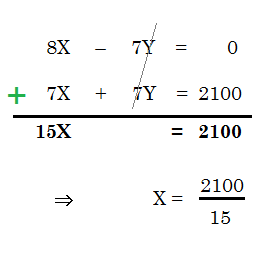
⇒ X = 140 grams Answer
Finally, let’s discuss the toughest question type and scenario that could come from mixtures in your exam:
There are 2 bars of gold-silver alloy; one piece has 2 parts of gold to 3 parts of silver and another has 3 parts of gold to 7 parts of silver. If both bars are melted into 8 kg bar with the final gold to silver ratio of 5 : 11. What was the weight of the first bar?
Solution:
I know your brain has mixed up while you have tried to attempt this question by your own. 😀
Calm dawn! Have a deep breath. It’s not your actual exam, it’s just your stage of improvement. You’ll improve by getting lessons from your failed attempts. And failure gives experience. Without failure, you are considered as inexperienced. Trust me, many people who got +90 percentile were exactly at similar level and position of facing failures in attempts like you are at present. So never loose your courage at any stage! Just remember that your run-rate is exactly similar to those who have top the exam. So you have opportunity to do even better. So let’s solve this.
As there are two pieces with gold to silver proportion as below:
In piece 1,
Gold : Silver
2 : 3
By supposedly converting in amount or grams (i.e numbers from ratios)
⇒ 2a : 3a
Now, in piece 2,
Gold : Silver
3 : 7
By supposedly converting in amount or grams (i.e numbers from ratios)
⇒ 3b : 7b
Now, it’s given that the Gold and Silver must exists in the final mixtures in a ratio of 5 : 11
In other word, we can say that total Gold in the final mixture (i.e 2a + 3b) to total Silver (i.e 3a + 7b) in the mixture ratio must be equals to 5 : 11
⇒ (2a + 3b)⁄(3a + 7b) = 5⁄11
⇒ 11(2a + 3b) = 5(3a + 7b)
⇒ 22a + 33b = 15a + 35b
⇒ 7a = 2b ————— (eq. 7)
Now,
Weight of first piece + weight of second piece = 8kg
⇒ (2a + 3a) + (3b + 7b) = 8kg
⇒ 5a + 10b = 8kg ————— (eq. 8)
Now, here again, you may put value of b from eq. 7 in above equation, to find value of a, or you may also use my preferred method as below:
From equation 7,
⇒ 7a – 2b = 0
Multiplying both sides by 5,
⇒ 35a – 10b = 0 ————— (eq. 9)
By adding equation 8 and equation 9, well get the result (do addition by your own).
⇒ 40a = 8kg
⇒ a = 1⁄5
Now, as we are required to find weight of first piece that is (2a + 3a = ) 5a,
By putting value of a here,
⇒ Weight of first piece = 1kg Answer